
Mahoning County’s Moving Arrest Log
Everything runs through the Mahoning County Sheriff's Office Recent Bookings query. One visit showed a heading reaching back to September 7, roughly five calendar days. The span moves. Treat that as a habit, not a promise of a five-day or weekly archive. The department publishes no separate weekly blotter of its own.
The wider range has real value. It keeps prior dates together. It can surface a late-day booking after the same-day question has passed. Agency labels mix MCSO with Youngstown Police, Boardman Police, Ohio State Patrol, U.S. Marshals, and ICE. Justice Center bookings anchor the list. It is not a record of every police contact in every Mahoning city. It also says nothing about crime rates.
The Sheriff's inmate hub lists the county's custody tools. That official page displays the multi-date query itself.
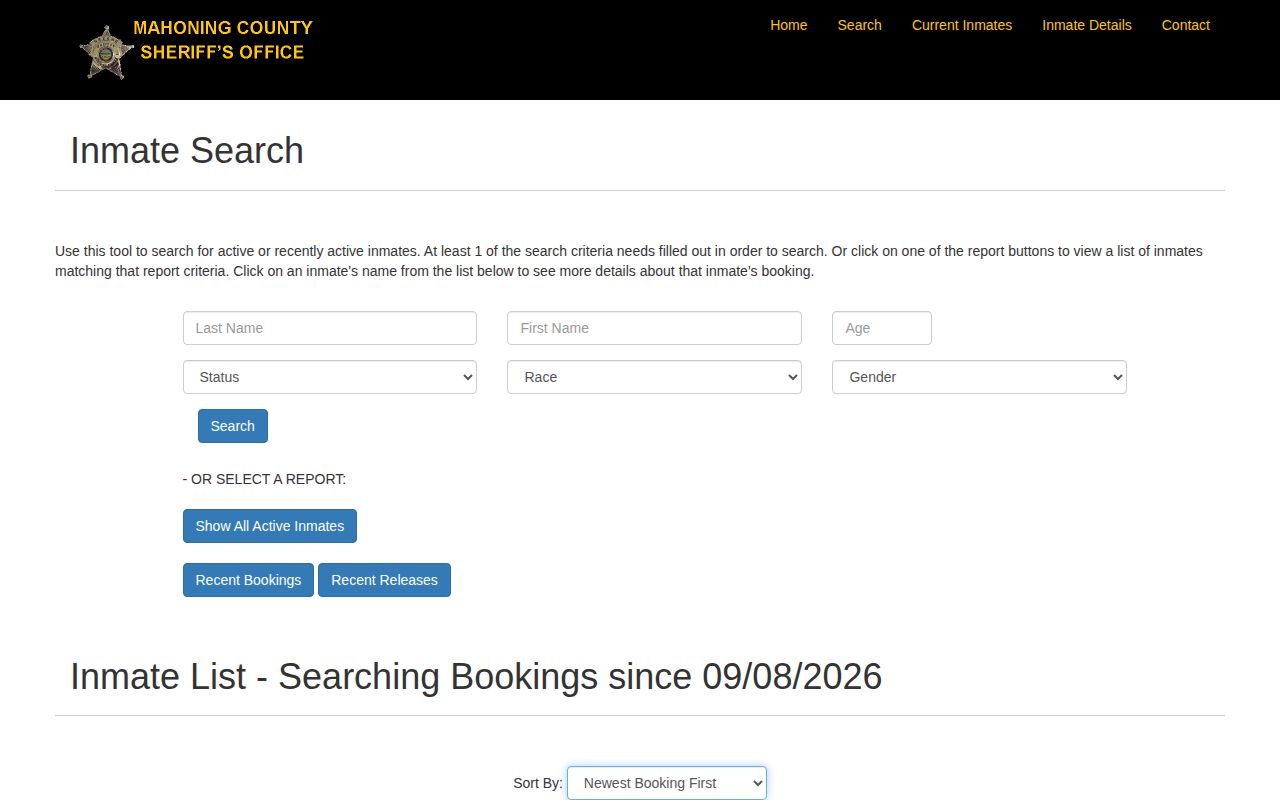
The heading and the individual booking dates define the useful range each day.
Reading the Mahoning Booking Blotter
Treat the page as a set of booking records inside its present range. A name alone won't pin down an event. The same issue applies to a booking photo. Names repeat, and one person can appear in more than one booking.
- Open Recent Bookings and record the “since” date.
- Work through the booking dates needed and compare full name, birth date, inmate ID, and booking number.
- Read the arresting-agency field instead of assuming which office made the arrest.
- Open a detail record for offense, bond, status, court, and next-court-date fields when available.
- Verify the later case through Mahoning County eCourts or the correct municipal court.
- For older material, give exact identifiers to MCSO Records Division.
Surname-first listings, aliases, and repeat bookings can look like duplicates. Check the booking number, inmate ID, date, and agency side by side. A blank release field only shows what the row displayed at that moment, so custody may still have changed after the page loaded.
Mahoning Arrest-Log Entry Fields
The official list carries compact identity and custody fields. A detail query can add more, though the public portal never shows every item gathered at jail admission.
| Entry field | How to read it |
|---|---|
| Name and DOB | Identity checks, subject to spelling, aliases, and similar names. |
| Inmate ID | A person-level key used across list and detail screens. |
| Booking number | The best reference for this particular intake. |
| Booking date | Places the event within the displayed multi-day range. |
| Arresting agency | The authority entered on the jail record, not necessarily the final prosecutor. |
| Release date | Release information when populated; it can change the relevant custody view. |
| Image control | An official booking-related image for the displayed entry. |
A detail screen may add physical descriptors, SID, status, offense text, bond, court, and a next court date. Read the offense text as the charge listed at booking. The court docket governs any later amendment, dismissal, plea, or conviction.
Weekend Dates and Posting Gaps
No MCSO page states a weekend or holiday publication rule. It gives no guaranteed delay from booking to web, and no hour-by-hour schedule. The wider date range helps after a weekend. Several days may sit together on one screen. Even so, the wider range cannot prove a "weekend surge." More rows on one date could reflect arrests, booking timing, transfers, or when records became public.
Check booking dates, not just the date you opened the page. Someone arrested late may still be in processing. A quick release can land a person in the recent-release view. A citation may never lead to Justice Center admission. That record may sit with a city police department or court instead.
Note: Date clusters in the moving query are not complete Mahoning County arrest statistics and should not be reported as trends.
Mahoning Jail Record Archives
The Sheriff's retention schedule names the Jail Record series. That series covers material once kept in the Jail Register, Prisoner Record, and Booking Card. The schedule marks it permanent when electronic. Paper copies can be destroyed after scanning and quality control under listed conditions. That rule says nothing about the query's archive depth.
For an older booking, call the MCSO Records Division at 330-480-5030. Have the full name, approximate date, booking number, and arresting agency ready. Describe the record sought. Ask about current cost and delivery method. The county sets no fixed booking-photo fee. It offers no response guarantee. Ohio public-record law permits exemptions and redactions. Juvenile, sealed, expunged, medical, victim, and confidential investigative information can all be restricted.
County Records Management describes older microfilm holdings and retrieval help. Its page does not confirm that jail photographs moved there. The Clerk may instead hold court files. Start with the office that created the record, then follow any documented transfer.
Retention and public visibility answer different questions. A permanent electronic Jail Record can stay in the agency's system. That can hold long after its row leaves the recent-booking query. Sealing orders, statutory exemptions, and redactions can also change access. An old news story, meanwhile, can linger online after the official custody page changes. Match every copy to the current agency and court sources before repeating it.
Local News Blotters Are Separate
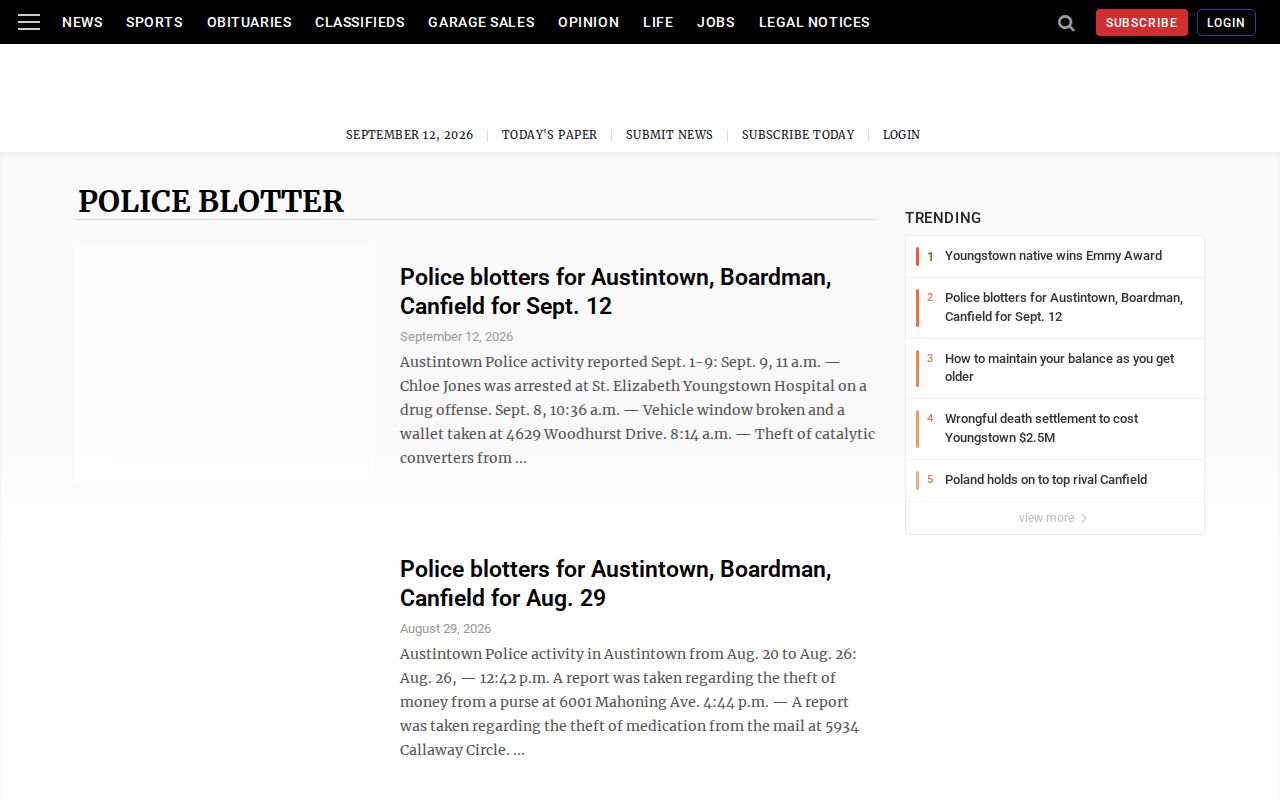
The Vindicator Police Blotter posts periodic date-range reports for communities like Austintown and Boardman, with times, places, incidents, arrests, charges, and warrants. It is journalism. It is not a jail feed. Routine entries there never form an official photo roster, so confirm each event through official jail and court sources.
Local outlets pick their own cases. Mahoning Matters, WFMJ, and WKBN each cover selected arrests in Mahoning County, but their schedules follow the news, not the jail. Photos run only with the article that used them.
A blotter may sort events by township, neighborhood, or jurisdiction rather than by booking date. It might list a warrant or citation. Some of those never produced a Justice Center booking. Editors may also hold a story until a police report or court filing arrives. News timing can't measure the Sheriff query's refresh rate.
Save the details when a report helps. Record the publication date, the incident date, the community, and the named source agency. Then match the person and event through a booking number, court case number, or an agency response, which keeps same-name people apart and stops an early charge from standing in as the final result.
An Arrest Log Is Not a Verdict
Bond and court-date fields deserve a second look. Bond can change. A hearing can move. Jurisdiction may shift between courts as a case develops.
So the log works best as a first pointer. Identify the booking, then follow the proceeding through the clerk or municipal court. That is where the current order lives. Copied lists can drift out of date. When a source conflicts with an official correction or order, drop the older version instead of circulating it as current.
From Booking to Another Custody State
Custody moves, and each list catches one moment. The multi-day query shows people recently received into the Mahoning County Justice Center. The active roster shows who stays in county custody. Recent releases mark a different transition. A prison sentence changes things again.
Someone sentenced to an Ohio prison belongs in the Department of Rehabilitation and Correction search. Immigration or federal custody has its own locator. An ICE or U.S. Marshals label on a county row does not make Mahoning County the prosecuting jurisdiction. Someone can also drop off a public list while the arrest stands, so keep the agency and booking identifiers, find the current custodian, and request the right source.